Start Fresh
You are not your title — you are what you carry forward

Over the past several nudges, we’ve strengthened one capacity at a time—Clarity, Curiosity, Connectedness, Collaboration, Composure, and Commitment. Each is like a muscle. We build it through practice, expanding our ability to respond to complexity and change. But muscles aren’t built to be admired individually. They’re built for the moments we need them.
This week, let’s watch them work together.
Last week, I promised to dig into what it means to start fresh.
This one is close to home. Every year on my birthday, I take a purposeful pause — to notice who I’m becoming, what I want to carry forward, and what I’m ready to set down. Birthdays, New Year, anniversaries: these landmark days are cultural invitations to begin again. And they work. Because in these moments our awareness is heightened, our motivation is strong, and there is a natural commitment to the intention we set.
But not every fresh start arrives on the calendar, gift-wrapped and celebratory. Some arrive uninvited.
Right now, one is arriving for almost all of us. AI is moving into our work at a speed that’s hard to metabolize. There’s real fear in it. We watch what it can do and quietly ask, “Will it replace me?” People who’ve been let go are hoping that by moving to a new company, they can keep the same title they held before, only to find the market bleak.
What if this moment is an invitation to start fresh?
Not by throwing away everything you’ve built...
But by discovering new ways to bring it forward in a changing landscape.
A few months ago, I was talking with a developer at one of my client sites. He’s the person everyone wants on their team — the one stakeholders line up for, who can be counted on to deliver superior work reliably. I wanted to know his secret. What I saw was a disciplined engineer: he listened closely to his customer, understood what was truly needed, designed the big picture as his blueprint, then delivered value in small iterations — value, he said, that the customer could touch and respond to. As a software engineer myself for many years, I recognized the wisdom immediately.
And then he said: “But wait — I’ve been playing with AI, and my approach is changing.”
He showed me. He now builds a live prototype with his customer using Claude, refining it together in real time. Once they're aligned, he brings the resulting code into Copilot to refactor and integrate it. Work that once took days now happens in minutes. He still leans on his own high-level design to validate the work and integrate it with the systems around it.
I was floored. So I asked the obvious question: “Aren’t you nervous it’s taking your job?”
“No,” he answered with a twinkle in his eye.
”I don’t see myself as a developer.
I see myself as a problem solver.
Now I can solve more problems, faster and better.”
Without realizing it, he was using every capacity we’d been practicing. He stayed curious instead of clinging to certainty. He held a systemic view while letting AI handle the local detail. He partnered with his customer instead of disappearing into solo execution. He met uncertainty with composure instead of fear. And through it all, his commitment never changed.
Watching him, I realized something. AI wasn't challenging his competence nearly as much as it was challenging his identity. As long as he saw himself as "someone who writes code," AI felt like a threat. The moment he saw himself as "someone who solves problems," AI became an amplifier.
His work changed because his identity expanded.
His engineering mastery didn’t disappear.
It became the foundation his expanded identity now stands on.
That's the Human Edge Navigator at work.
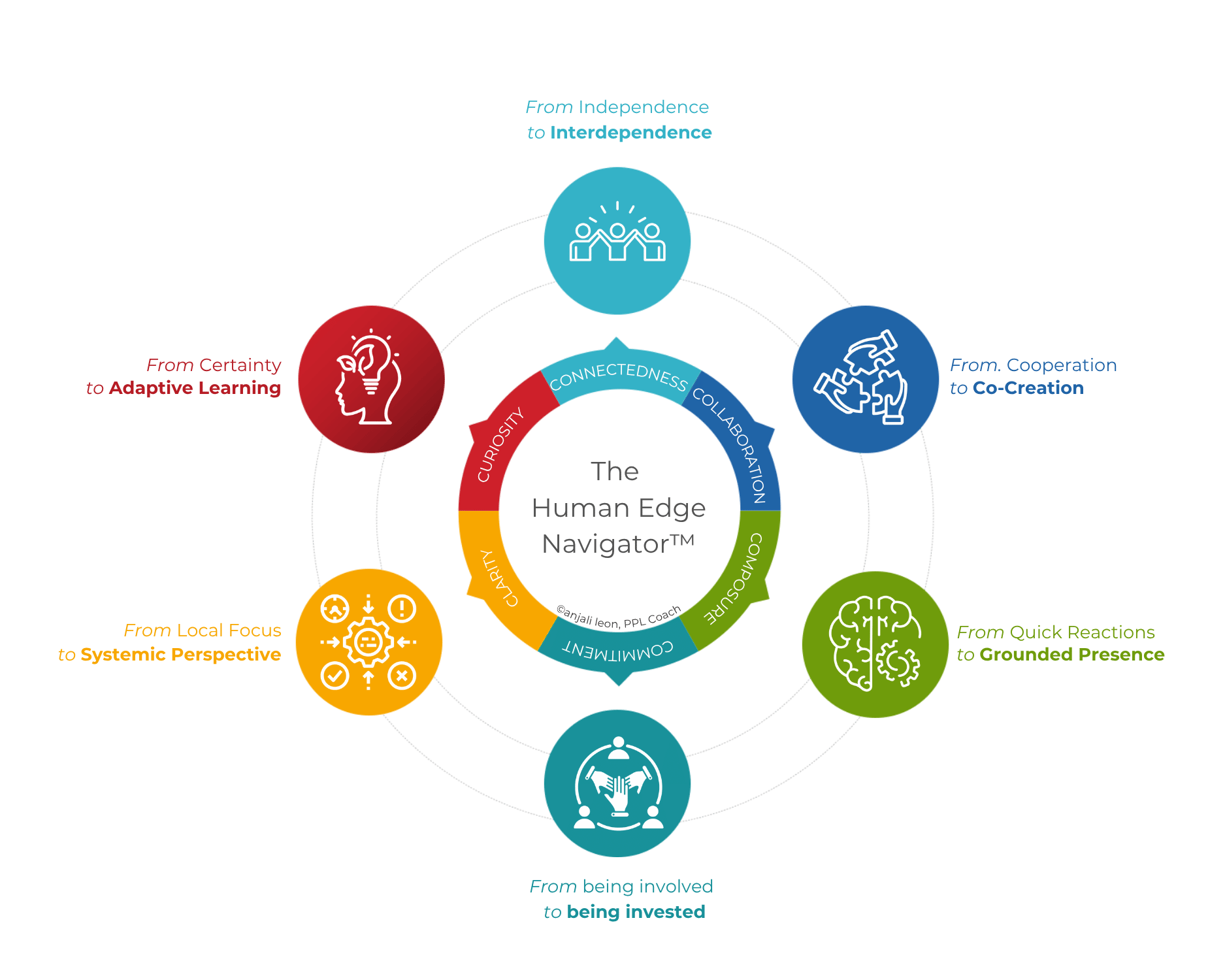
If you’ve followed these nudges for a while, you’ll recognize this as the Collaborative Leadership Navigator.
Over the past year, though, the work has evolved.
Today I think of it more broadly as the Human Edge Navigator™, because these capacities aren’t just for collaborative leadership.
They’re how we navigate change, uncertainty, and possibility—as humans, individually and together.
As you look at the wheel, notice something: each pair represents a range, not a destination.
From Certainty to Adaptive Learning.
From Local Focus to Systemic Perspective.
From Involved to Invested.
As each capacity grows stronger, so does your ability to move across that range—to respond with what the moment actually calls for, rather than simply reacting from habit.
That’s what this problem solver did.
And that’s what gives us the leverage to start fresh—not by erasing who we’ve been, but by expanding into who we’re becoming.
THIS WEEK’S NUDGE
Ask yourself: Who are you — beyond your title, your position, your function? What value do you bring that is distinctly yours? Sit with it longer than is comfortable.
And if you lead others, help them ask it too. You empower yourself, and you empower them, the same way — by helping each other find the larger container that holds your identity.
Next week, I’ll show you how I walked myself through the Navigator — capacity by capacity — to answer that question on this birthday and where I landed.
TO CARRY FORWARD:
What becomes possible now that you've reframed the value you bring?
What capacity is this moment actually asking of you — and which are you defaulting to instead?
This is the first post in a new series on the Human Edge Navigator™ — how the six capacities we’ve been building one at a time come alive, together, in the moments that matter most.
The Human Edge Navigator™ — Clarity · Curiosity · Connectedness · Collaboration · Composure · Commitment.
A note on how this was made: I shaped this piece with the help of AI — which feels fitting for a post about expanding our range rather than surrendering it. The stories, the framework, and the final words are mine.